Western ecommerce tutorials assume card payments, trusted addresses, and integrated shipping labels. Pakistan’s market runs on cash on delivery, WhatsApp confirmations, and courier booking, a different sport with different rules. This is the complete WooCommerce setup for how Pakistani customers actually buy, from someone who builds these stores.
In Pakistan, the sale doesn’t close at checkout. It closes at the doorstep, and everything in between is where stores win or lose money.
Why WooCommerce fits this market
Shopify works here, but its monthly fees, transaction costs, and thinner local COD/courier tooling bite harder in a COD-dominated market. WooCommerce is free software you own, with full control over the COD flow, local gateways, and courier plugins the Pakistani market has actually built tooling for. For most local stores, it’s the right call, the trade-off is that you own the maintenance too.
That maintenance is real: plugin updates, backups and checking that checkout still works after each update. Store owners who would rather not do it themselves can put the store on my website maintenance service. If you are already on Shopify and your main complaint is speed, moving is not always the answer; read why your Shopify store is slow and what fixes it first.
Cash on delivery, done properly
COD still carries the large majority of Pakistani ecommerce orders. Enabling the checkbox is trivial; running COD profitably is the actual work, because every fake or refused order costs you the round-trip courier fee.
The confirmation layer
Never dispatch a COD order blind. Insert a confirmation step between order and shipment: an automated WhatsApp or SMS asking the customer to confirm, with unconfirmed orders held. This one step typically cuts return losses dramatically. It filters the impulse orders and fake entries before they cost courier money.
Send the confirmation within minutes, not the next morning. Interest cools fast, the same way a lead goes cold when nobody replies; my piece on why most real estate websites never generate a lead makes the same point about follow-up speed.
Order-level defenses
Require a valid phone number format at checkout, flag repeat COD-refusers by number, and consider a small advance (even Rs. 200 via wallet) on high-value orders, customers with skin in the game receive their parcels.
The payment mix beyond COD
Offer digital payment alongside COD, not instead of it. Wallet payments and cards through Pakistani gateways serve customers who prefer prepaid, and every prepaid order is a return-risk removed. Whichever gateways you choose, test the full failure path: what the customer sees when a payment fails determines whether they retry or abandon.
Make the prepaid option visible on the checkout page itself, not hidden behind a dropdown. Some stores give prepaid customers a small reason to choose it, such as faster dispatch. Whatever you offer, state it plainly next to the payment options.
Courier integration, from phone calls to dashboard
Manual courier booking survives to about 10 orders a day, then it collapses. TCS, Leopards, PostEx, Trax, and the aggregator platforms all have WooCommerce integrations that book shipments, generate labels, and pull tracking numbers back into the order, so "where is my order?" answers itself. Pick your courier by COD remittance speed and coverage of your actual customer cities, not by brand familiarity; remittance delays are a silent cash-flow killer for growing stores.
Before launch, book a real test shipment through the integration and follow it to the end. Check that the label prints correctly, the tracking number lands in the order and the customer’s notification shows it.
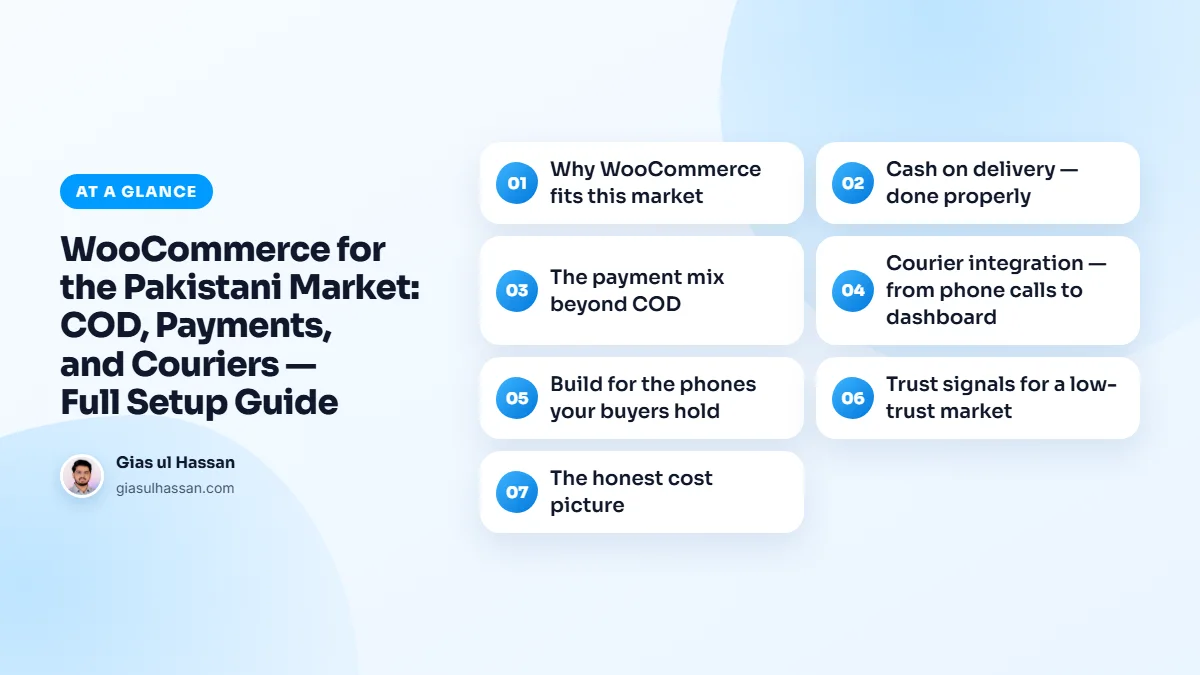
Build for the phones your buyers hold
Pakistani ecommerce traffic is overwhelmingly mobile, often on mid-range phones over mobile data. That means compressed WebP product images, a checkout that works one-handed with minimal fields, and city dropdowns instead of free-text address chaos. Speed is revenue here: a product page that takes six seconds on 4G never gets to show its price. (The same discipline from my speed optimization work applies double to stores.)
Let customers check out as guests. Forcing an account before the first order is one more step between an impulse and a sale. Gyms lose members to exactly this kind of friction, as I explain in why gym websites fail to turn visitors into members, and the fix is the same: make the next step effortless.
Trust signals for a low-trust market
First-time buyers here have been burned. Counter it visibly: real product photos (not supplier renders), a working phone number and address, an easy-returns page in plain language, and screenshots of customer reviews from WhatsApp, social proof in the format Pakistani buyers actually trust.
A WooCommerce Pakistan launch checklist
Before you announce the store, run through this list on a real phone, over mobile data:
- Place a COD order and confirm the WhatsApp or SMS confirmation arrives.
- Enter a badly formatted phone number and check that checkout rejects it.
- Pick a city from the dropdown and check the delivery charge is right.
- Pay with each digital method, then deliberately fail a payment and read the message the customer sees.
- Book a test shipment and confirm the tracking number appears on the order.
- Open the returns page, phone number and WhatsApp link from the footer.
- Confirm backups are running before the first real order arrives.
Mistakes that cost Pakistani stores money
- Dispatching unconfirmed COD orders. Every refusal is a courier fee paid twice.
- Free-text address fields. Riders lose time, parcels come back, and you pay for both.
- Supplier renders instead of real photos. They look like every other store selling the same item.
- Ignoring remittance timing. A courier that pays slowly can starve a growing store of stock money.
The honest cost picture
WooCommerce itself is free; the real costs are decent hosting, the courier/gateway plugins, and the build. What decides the price is catalog size, payment mix, and courier automation depth, which is why serious stores get scoped individually. That’s how I quote Pakistani ecommerce builds: a fixed number covering the COD flow, courier integration, and mobile-first speed, before any work starts.